The Hidden Design Constraints of Samarium Cobalt Magnets: What Engineers Need to Know

The Hidden Design Constraints of Samarium Cobalt Magnets: What Engineers Need to Know
How to Select the Right Neodymium Magnet Grade (Without Over‑Engineering)

SmCo Is Exceptional. It’s Also Unforgiving.

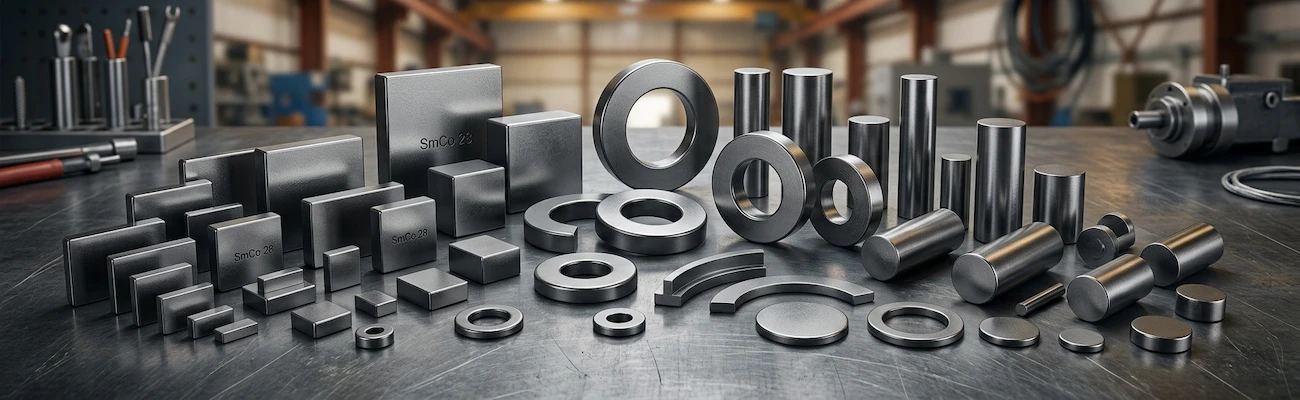
Samarium cobalt magnets are chosen for demanding applications precisely because they perform where other materials fail. That performance comes from a highly ordered crystalline structure that is, by nature, hard and brittle. Engineers who understand this from the start design better programs. Those who don’t encounter problems at the worst possible time: during prototyping, assembly, or qualification.

Constraint 1: Brittleness Is the Governing Design Variable

SmCo magnets chip and crack under mechanical stress, impact, or vibration. Unlike ductile metals, they have almost no tolerance for tensile loading or localized stress concentrations. This is not a defect—it is a material property that must be designed around.

What this means in practice:

  • Assemblies that expose SmCo to shock or vibration require mechanical support, encapsulation, or protective housing
  • Press fits are high-risk—adhesive bonding or compliant retention is preferred
  • Handling procedures must be defined and enforced from prototype through production

Constraint 2: Conventional Machining Doesn’t Apply

SmCo cannot be drilled, turned, or milled with standard tooling. Material removal requires abrasive grinding or EDM, typically completed before magnetization. Complex features—sharp internal corners, thin walls, small holes—significantly increase fracture risk and drive scrap rates up.

Best practice:

  • Favor near-net-shape designs that minimize post-sinter machining
  • Limit machining to critical dimensions only
  • Avoid features that concentrate stress or require multiple setups

Constraint 3: Tolerance Strategy Requires Early Decisions

Tight tolerances are achievable with SmCo — but they cost more and increase fracture risk. Engineers must decide early how dimensional variation will be managed in the assembly. The most reliable approach is to design assemblies that can accommodate realistic tolerances through adhesive bonding, compliant features, or mechanical retention rather than demanding precision that adds risk and cost.

Why These Constraints Are Manageable—With the Right Process

None of these constraints are reasons to avoid samarium cobalt. They are reasons to approach SmCo programs with a manufacturing-first mindset. When brittleness, geometry, and tolerance strategy are addressed at the design stage—not after the first prototype fails—SmCo programs run smoothly from development through production.

How Allstar Removes the Risk 
Allstar Magnetics reviews SmCo designs for manufacturability from the first conversation. We evaluate geometry, tolerance allocation, handling risk, and assembly method before design is locked—reducing the chance of surprises at prototype or qualification.

Read more: Samarium Cobalt Design and Manufacturing Considerations ⇒

Talk to an Engineer: Before you finalize your SmCo design, speak with one of our engineers ⇒

WORK WITH ALLSTAR

Not every magnet challenge has an obvious answer — but the right conversation usually finds one. If you're dealing with a sourcing problem, a legacy spec, or a design that needs a second look, talk to Jason directly

Jason Berry
Sales — Permanent Magnets (West)
jberry@allstarmagnetics.com
360-200-5675 DIRECT DIAL  
 

ADDITIONAL RESOURCES

Why Standard Ferrite Cores Aren’t Enough—and What Precision Gluing Makes Possible

Why Standard Ferrite Cores Aren’t Enough—and What Precision Gluing Makes Possible

Precision Gluing

When off-the-shelf components hit their limits, bonded ferrite assemblies open new design possibilities.

The Problem Engineers Hit Every Day

You may have a transformer or inductor design that works perfectly on paper. The magnetic circuit is right, the flux path is optimized, and the dimensions are dialed in—and then the search for a matching ferrite core begins. That's when many engineers discover the part they need simply doesn't exist.

Standard ferrite cores are manufactured by pressing, which imposes hard limits on achievable size and geometry. If your design calls for a cross-section or length beyond what a single-piece pressing can produce, you're either forced to redesign around available inventory or start from scratch.

This is one of the most common constraints engineers face when developing custom magnetics for high-power transformers, large-format inductors, and specialized EMI suppression components.

Precision Ferrite Gluing: A Different Approach

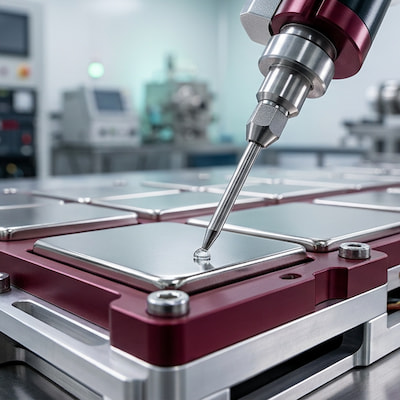
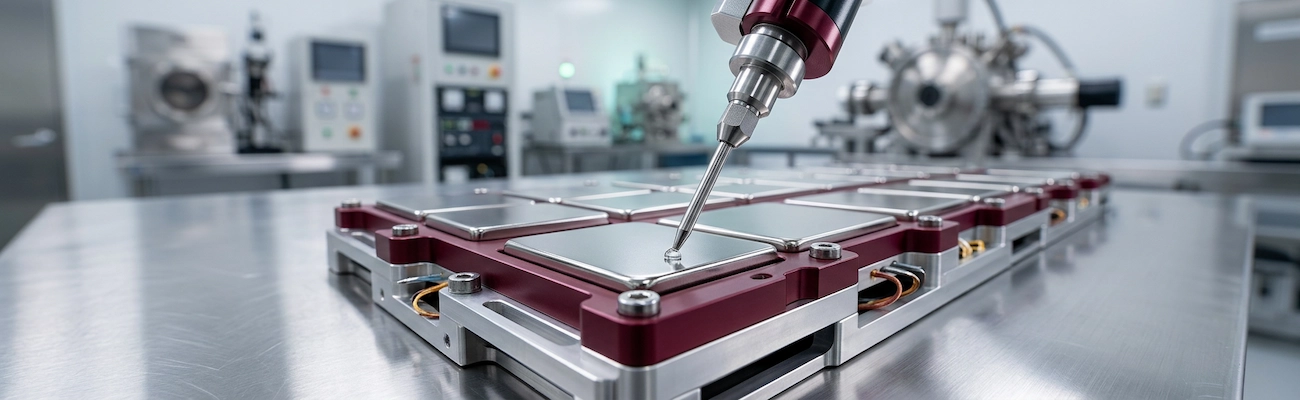
Precision bonding of ferrite core sections makes it possible to build magnetic assemblies that exceed the size limits of single-piece manufacturing. By joining ferrite segments with controlled adhesives and custom fixturing, engineers can create core geometries that simply can't be pressed in one piece.

The result is a custom UCore, ECore, or other assembly with the magnetic performance of a monolithic component—without the constraints.

But there's a catch. Ferrite is not a forgiving material. It's porous, brittle, and sensitive to alignment. Bonding ferrite cores is a fundamentally different challenge from bonding other materials, and getting it wrong introduces reluctance into the magnetic circuit, compromises dimensional stability, and creates quality problems that won't show up until production.

What Makes Ferrite Gluing Technically Difficult

Ferrite bonding requires careful control of several variables that don't exist in standard assembly processes:

  • Porous surfaces absorb adhesive differently than dense metals or plastics—adhesive systems must be selected and applied to account for this behavior
  • Bond line thickness must be held to 10–50 µm to avoid introducing reluctance into the magnetic circuit
  • Squareness and alignment must be maintained across the bonded interface to preserve flux path geometry
  • Low-shrinkage adhesive formulations are required to minimize post-cure stress on a brittle material
  • Temperature performance must be matched to the transformer's operating environment

Managing all these variables consistently—from prototype through production—requires process documentation, validated cure parameters, and fixturing designed specifically for ferrite.

The Allstar Approach: Manufacturing-First from Day One

At Allstar Magnetics, precision ferrite gluing begins before a prototype is built. Engineers review each design for production readiness—evaluating material behavior, tolerance strategy, alignment requirements, and process scalability as a system.

That means adhesive selection, fixturing design, and cure process development all move forward alongside design refinement—not after the fact. The result is a bonded ferrite assembly that performs at prototype stage and scales into volume production without disruptive process changes.

The Allstar Difference

What is validated at prototype translates directly into volume production. Documented work instructions, validated cure parameters, and repeatable fixturing systems are built in from the start—so the transition from prototype to production is predictable rather than problematic.

Real-World Results: A Ferrite UCore Beyond Conventional Limits

A leading equipment manufacturer came to Allstar with a requirement for a large ferrite UCore that exceeded what any off-the-shelf option could provide. The core needed to meet tight tolerances, maintain structural integrity, and be manufacturable at scale.

Allstar's engineering team co-developed a bonded ferrite solution through a focused prototype run, validating mechanical fit, dimensional accuracy, and in-system performance before transitioning to production. The result: a custom UCore that delivered the required size and precision while remaining cost-effective—and the basis for an ongoing engineering partnership as the customer continues to expand its ferrite core requirements.

When to Consider Precision Ferrite Gluing

Precision ferrite bonding is the right approach when:

  • Your design requires a core cross-section or length that exceeds single-piece pressing limits
  • Standard catalog geometries can't match your specific flux path requirements
  • You need a non-standard form factor to fit within a constrained footprint
  • You're developing a custom transformer or inductor for high-power or specialty applications
  • You need a scalable, production-ready solution—not a one-off workaround

Need a ferrite core solution beyond standard catalog limits? Contact Allstar Magnetics to discuss your application and request a quote.

Allstar Magnetics is an AS9100, AS9120, and ISO 9001:2015 certified manufacturer of precision magnetic assemblies, ferrite core solutions, and permanent magnet products, and is ITAR registered.

Allstar Magnetics - ISO - AS9100D Certification
Allstar Magnetics - ITAR Certification

Ready to power your next breakthrough?

Contact Allstar Magnetics to discover how our turnkey approach can simplify your supply chain and deliver the results your team needs to succeed.

How to Select the Right Neodymium Magnet Grade (Without Over-Engineering It)

May 2026: Issue 9

Shaunmarie Gutbezahl

Samarium Cobalt & Neodymium

Choosing a neodymium magnet isn't as simple as picking the strongest option on the shelf. The most common selection mistakes don't come from going too weak — they come from over specifying in the wrong direction. Temperature, coercivity, supply chain risk, and system-level design all play a role that a datasheet alone won't tell you.

The right grade is the one that performs reliably across your application's full operating life — not just on day one.

When Your Legacy Spec Becomes a Sourcing Dead End

It's a situation more common than most engineers expect. A design was built around a samarium cobalt magnet — a perfectly reasonable choice at the time. The product shipped, performed well, and then years later the supply chain simply disappeared. The original supplier was gone, and every alternative either couldn't hit the spec or couldn't hit the price.

"We needed these magnets. We'd been using SmCo for years and just assumed that's what we had to keep using."

What looked like a sourcing problem turned out to be a spec problem. And it only took one conversation to figure that out.

When this customer brought their challenge to Allstar Magnetics, the team didn't lead with catalogs or lead times — they started by asking how the magnet was actually being used. The answer changed everything. The application never reached the elevated temperatures that had originally justified samarium cobalt. A high-temperature neodymium grade would perform just as well — and unlike SmCo, it required no export license and could be sourced reliably and quickly.

No costly redesign. No regulatory burden. Just the right magnet, finally matched to the real operating conditions.

Read the full case study to see how one question unlocked a smarter, sourceable solution.

A Case Study: The Right Magnet Was Already Out There.

A Case Study: The Right Magnet Was Already Out There.

How One Question Unlocked a Smarter, Sourceable Solution

Zero

Export License Required

1 Call

To Identify the Right Solution

Faster

Sourcing & Leading Time

THE SITUATION

A Legacy Design. A Sourcing Dead End.

A customer came to Allstar Magnetics with a problem that had quietly become a crisis. Years earlier, one of their engineers had designed a critical component around a samarium cobalt (SmCo) magnet — a perfectly reasonable choice at the time. The part worked. The product shipped. And then, eventually, they needed more.

The problem: they couldn't find anyone to make the magnets. Their original supplier was gone, and every new source they approached either couldn't meet the spec or couldn't meet it at a viable price. The design had become a bottleneck — and the clock was ticking.

"We needed these magnets. We'd been using SmCo for years and just assumed that's what we had to keep using."

THE INSIGHT

A Few Questions Changed Everything.

When Jason at Allstar Magnetics got on the phone with the customer, he didn't start with catalogs or lead times. He started with questions about how the magnet was actually being used.

It didn't take long to find the key fact: the application never actually reached the elevated temperatures that had originally justified using samarium cobalt. SmCo had been specified — likely out of caution or habit — but the thermal demands of the real-world environment were well within the range of a different material entirely.

Jason identified that a high-temperature neodymium (NdFeB) magnet would perform just as well in this application. It could handle the actual operating temperatures. It met the magnetic performance requirements.

And critically — unlike samarium cobalt — it did not require an export license, removing a layer of regulatory complexity that had been adding friction and cost to the original spec.

THE OUTCOME

Sourceable. Compliant. Delivered.

With the material switch confirmed, Allstar moved quickly. The high-temp neodymium magnet matched the form, fit, and function of the original design. The customer avoided a costly redesign effort, eliminated the export licensing burden, and finally had a reliable, repeatable supply path for a part that had been holding them up.

The original SmCo specification wasn't wrong — it just hadn't been revisited. One conversation with someone who asked the right questions was all it took to unlock a better solution.

WORK WITH ALLSTAR

Not every magnet challenge has an obvious answer — but the right conversation usually finds one. If you're dealing with a sourcing problem, a legacy spec, or a design that needs a second look, talk to Jason directly

Jason Berry
Sales — Permanent Magnets (West)
jberry@allstarmagnetics.com
360-200-5675 DIRECT DIAL  
ADDITIONAL RESOURCES

SmCo vs. Neodymium Choosing the Right Rare-Earth Magnet for Your Application

SmCo vs. Neodymium Choosing the Right Rare-Earth Magnet for Your Application


Warning: Undefined array key "badge_alignment" in /var/www/vhosts/trial2806939.mbws.vn/httpdocs/wp-content/plugins/diviflash/Builder/Server/Modules/TableRow/TableRow.php on line 136

Warning: Undefined array key "badge_alignment" in /var/www/vhosts/trial2806939.mbws.vn/httpdocs/wp-content/plugins/diviflash/Builder/Server/Modules/TableRow/TableRow.php on line 139

Warning: Undefined array key "badge_alignment" in /var/www/vhosts/trial2806939.mbws.vn/httpdocs/wp-content/plugins/diviflash/Builder/Server/Modules/TableRow/TableRow.php on line 136

Warning: Undefined array key "badge_alignment" in /var/www/vhosts/trial2806939.mbws.vn/httpdocs/wp-content/plugins/diviflash/Builder/Server/Modules/TableRow/TableRow.php on line 139

Warning: Undefined array key "badge_alignment" in /var/www/vhosts/trial2806939.mbws.vn/httpdocs/wp-content/plugins/diviflash/Builder/Server/Modules/TableRow/TableRow.php on line 136

Warning: Undefined array key "badge_alignment" in /var/www/vhosts/trial2806939.mbws.vn/httpdocs/wp-content/plugins/diviflash/Builder/Server/Modules/TableRow/TableRow.php on line 139

Warning: Undefined array key "badge_alignment" in /var/www/vhosts/trial2806939.mbws.vn/httpdocs/wp-content/plugins/diviflash/Builder/Server/Modules/TableRow/TableRow.php on line 136

Warning: Undefined array key "badge_alignment" in /var/www/vhosts/trial2806939.mbws.vn/httpdocs/wp-content/plugins/diviflash/Builder/Server/Modules/TableRow/TableRow.php on line 139

Warning: Undefined array key "badge_alignment" in /var/www/vhosts/trial2806939.mbws.vn/httpdocs/wp-content/plugins/diviflash/Builder/Server/Modules/TableRow/TableRow.php on line 136

Warning: Undefined array key "badge_alignment" in /var/www/vhosts/trial2806939.mbws.vn/httpdocs/wp-content/plugins/diviflash/Builder/Server/Modules/TableRow/TableRow.php on line 139

Warning: Undefined array key "badge_alignment" in /var/www/vhosts/trial2806939.mbws.vn/httpdocs/wp-content/plugins/diviflash/Builder/Server/Modules/TableRow/TableRow.php on line 136

Warning: Undefined array key "badge_alignment" in /var/www/vhosts/trial2806939.mbws.vn/httpdocs/wp-content/plugins/diviflash/Builder/Server/Modules/TableRow/TableRow.php on line 139

Warning: Undefined array key "badge_alignment" in /var/www/vhosts/trial2806939.mbws.vn/httpdocs/wp-content/plugins/diviflash/Builder/Server/Modules/TableRow/TableRow.php on line 136

Warning: Undefined array key "badge_alignment" in /var/www/vhosts/trial2806939.mbws.vn/httpdocs/wp-content/plugins/diviflash/Builder/Server/Modules/TableRow/TableRow.php on line 139
How to Select the Right Neodymium Magnet Grade (Without Over‑Engineering)

Why This Question Matters More Than Most Engineers Expect

Neodymium and samarium cobalt are both rare-earth permanent magnets. They’re often listed side-by-side in material selection guides, and at first glance the choice seems straightforward: neodymium is stronger, samarium cobalt handles heat better. Choose accordingly.

In practice, the decision is more nuanced — and choosing the wrong material early in a design program can mean expensive redesigns, qualification failures, or field performance issues that trace back to a material tradeoff that wasn’t fully evaluated at the start.

Where Neodymium Excels

Neodymium (NdFeB) delivers the highest energy product of any permanent magnet material commercially available. If your application needs maximum field strength in minimum volume, and if operating temperatures stay well below 150°C, neodymium is usually the right answer.

  • Highest available magnetic strength (BHmax)
  • Cost-effective for most commercial applications
  • Wide range of grades and geometries available
  • Well-understood manufacturing and supply chain

The tradeoffs: neodymium is susceptible to thermal demagnetization at elevated temperatures, requires protective coatings to prevent corrosion, and its magnetic output decreases more significantly with temperature rise than SmCo.

Where SmCo Is the Right Choice

Samarium cobalt becomes the better engineering choice when one or more of the following are true:

  • Operating temperatures exceed 150°C, or fluctuate widely and unpredictably
  • The application is in a corrosive, humid, or chemically aggressive environment
  • Long-term magnetic stability is required without recalibration or compensation
  • The design is in aerospace, defense, or medical where qualification standards are strict
  • Performance drift over the product’s service life is not acceptable

The Decision Framework

If you need ... Consider
Maximum field strength, moderate temperature Neodymium (NdFeB)
Stable output at high or variable temperatures Samarium Cobalt (SmCo)
Corrosion resistance without coatings SmCo
Long service life with minimal drift SmCo
Cost-optimized commercial application Neodymium or Ferrite
Aerospace, defense, or medical grade SmCo (often specified by requirement)

A Note on Cost

SmCo costs more than neodymium per unit. Engineers and procurement teams often push back on this. The right question, however, isn’t “why does SmCo cost more?” — it’s “what does magnetic performance failure cost in this application?” In high-reliability systems, the premium on the magnet is typically far smaller than the cost of a field failure, system recalibration, or redesign cycle.

The Takeaway Worth Bookmarking Neodymium and SmCo serve different engineering needs. The strongest magnet is rarely the most reliable one for demanding environments. If your application involves elevated temperature, harsh conditions, or long service life requirements, SmCo deserves a serious look. Allstar Magnetics works with engineering teams to evaluate both materials early — before the design is locked.

Samarium Cobalt Magnets — Material Overview and Engineering Guide

Ready to power your next breakthrough?

Contact Allstar Magnetics to discover how our turnkey approach can simplify your supply chain and deliver the results your team needs to succeed.