
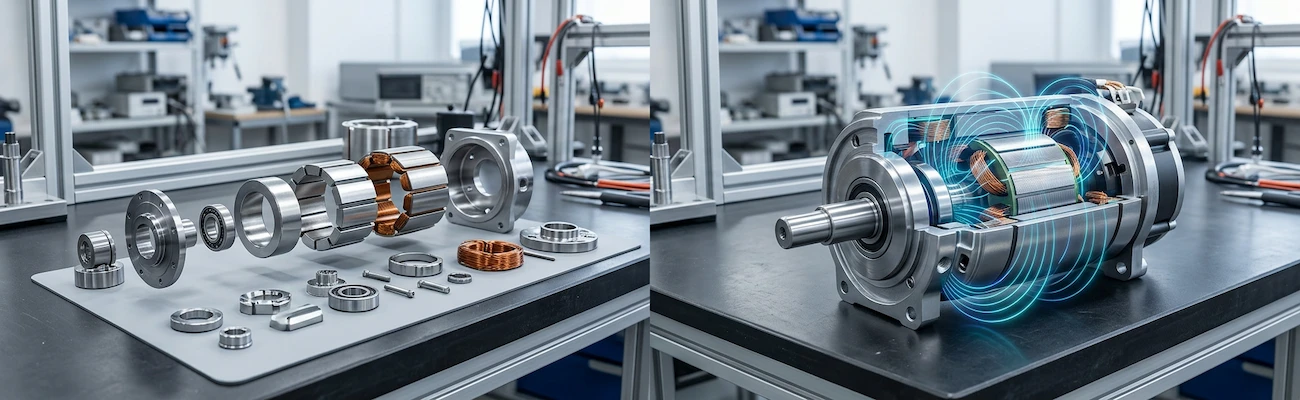
Two different materials. Two distinct bonding processes. One manufacturing-first approach. Here's what every engineer needs to know before specifying a bonded magnetic assembly.
Why the Distinction Between 'Magnetic' and 'Magnet' Assemblies Matters
In the magnetics industry, two terms are often used interchangeably—but shouldn't be. Magnetic assemblies and magnet assemblies refer to fundamentally different products, made from different materials, using different bonding processes, for different applications.
Getting this distinction right matters before you specify, quote, or begin development on a bonded assembly. The material properties, adhesive requirements, fixturing challenges, and performance outcomes are different in every meaningful way.
Magnetic Assemblies (Ferrite Cores)
A magnetic assembly is built from ferrite cores—materials that guide and shape magnetic flux. Ferrite is not a permanent magnet. It's a ceramic material used in transformers, inductors, and EMI suppression components because of its ability to conduct magnetic flux efficiently at high frequencies.
When engineers bond ferrite cores together, they're creating larger raw-material structures—UCores, ECores, or other geometries—that can't be manufactured as single pressed pieces. The goal is a continuous, low-reluctance magnetic circuit with a custom cross-section or length.
Magnet Assemblies (Permanent Magnets)
A magnet assembly involves permanent magnets—neodymium iron boron (NdFeB), samarium cobalt (SmCo), ceramic ferrite, or alnico—bonded to steel backing structures to create functional components for motors, linear drives, and precision motion systems.
Here, bonding isn't about creating a larger magnetic material—it's about integrating a functional magnet precisely into its working structure. Position, retention, and field geometry are what matter.
Side-by-Side: Ferrite Core Gluing vs. Permanent Magnet-to-Steel Bonding
Purpose: Ferrite gluing creates larger raw-material cores for custom transformer and inductor manufacturing. Magnet-to-steel bonding integrates permanent magnets into functional motor, drive, and motion system hardware.
Why it's difficult (ferrite): Porous surfaces, brittleness, bond line thickness control (10–50 µm), alignment sensitivity, and repeatable production demands.
Why it's difficult (magnets): Magnetic forces during assembly, thermal expansion mismatch, gap control for rotor balance, fatigue resistance, and environmental durability.
Adhesive approach (ferrite): Low-shrinkage formulations compatible with porous ceramic surfaces; bond line control is critical to preserve circuit performance.
Adhesive approach (magnets): Structural epoxies, two-component epoxies, or acrylics selected for shear strength, fatigue resistance, and environmental performance.
Typical applications (ferrite): Custom transformer cores, large-format inductors, EMI suppression components, power electronics magnetics.
Typical applications (magnets): Rotors, linear motor magnet tracks, shaft-integrated magnet assemblies, precision motion hardware, defense actuation systems.
What Both Processes Have in Common: A Manufacturing-First Mindset
Despite their differences, both ferrite bonding and permanent magnet-to-steel bonding share a critical requirement: the bonding process must be designed for production from the beginning, not adapted after the fact.
This is where many bonding projects run into problems. An adhesive that works on a bench prototype may not deliver consistent results in volume production. A fixturing approach that works for ten units may not hold tolerances for a thousand. Cure conditions that perform in a controlled environment may not translate to a manufacturing floor.
At Allstar Magnetics, both processes start with a production-readiness review before adhesive selection, fixturing design, or prototype build. Material behavior, tolerance strategy, alignment requirements, and process scalability are evaluated as a system—so the prototype that passes validation is the same process that runs at volume.
How to Know Which Process You Need
If you're designing a transformer, inductor, or EMI component that requires a core geometry beyond standard catalog options—you need ferrite core gluing.
If you're building a motor, linear drive, or precision motion system that requires magnets bonded to steel—you need permanent magnet-to-steel bonding.
If you're not sure which applies to your design, Allstar engineers can review your application and recommend the right approach.
Questions to Ask Before Specifying a Bonded Magnetic Assembly
- Is your material ferrite (for flux guidance) or a permanent magnet (for field generation)?
- What are your tolerance and alignment requirements for the bonded interface?
- What mechanical and environmental loads will the assembly see in service?
- Does your supplier have documented, validated bonding processes—or are they developing them on your program?
- Is the process designed to scale from prototype to production without changes?
The Allstar Advantage: One Partner for Both Processes
Allstar Magnetics is one of the few magnetic component manufacturers with deep engineering expertise in both ferrite core bonding and permanent magnet-to-steel bonding. That breadth matters when a single program requires both—or when requirements evolve as a design matures.
With AS9100, AS9120, and ISO 9001:2015 certifications and ITAR registration, Allstar serves customers across industrial, defense, aerospace, and power electronics markets where bonded assemblies must perform reliably from first prototype through high-volume production.
Contact Allstar Magnetics to discuss your bonded assembly requirements: sales@allstarmagnetics.com