Why Standard Ferrite Cores Aren’t Enough—and What Precision Gluing Makes Possible
When off-the-shelf components hit their limits, bonded ferrite assemblies open new design possibilities.
The Problem Engineers Hit Every Day
You may have a transformer or inductor design that works perfectly on paper. The magnetic circuit is right, the flux path is optimized, and the dimensions are dialed in—and then the search for a matching ferrite core begins. That's when many engineers discover the part they need simply doesn't exist.
Standard ferrite cores are manufactured by pressing, which imposes hard limits on achievable size and geometry. If your design calls for a cross-section or length beyond what a single-piece pressing can produce, you're either forced to redesign around available inventory or start from scratch.
This is one of the most common constraints engineers face when developing custom magnetics for high-power transformers, large-format inductors, and specialized EMI suppression components.
Precision Ferrite Gluing: A Different Approach
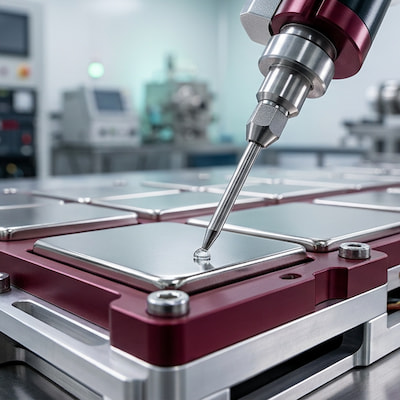
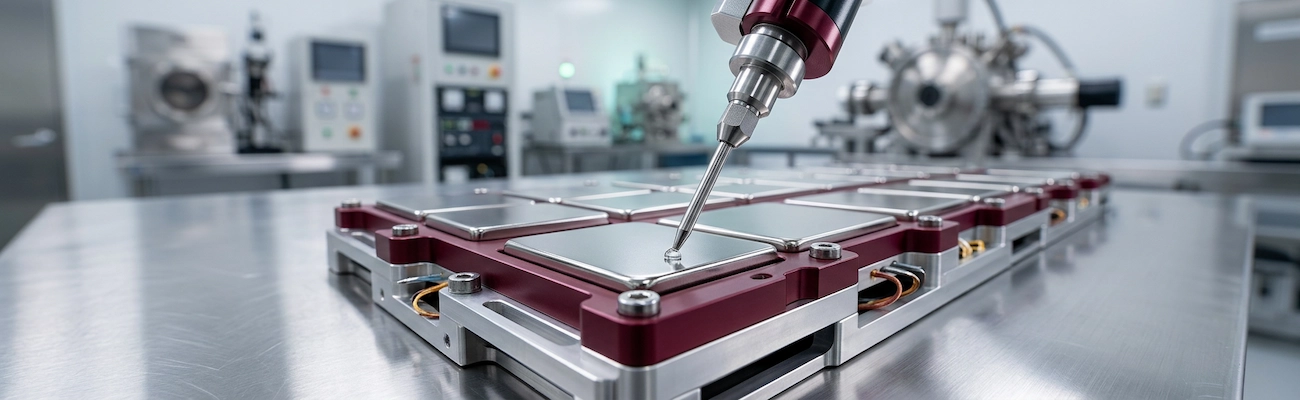
Precision bonding of ferrite core sections makes it possible to build magnetic assemblies that exceed the size limits of single-piece manufacturing. By joining ferrite segments with controlled adhesives and custom fixturing, engineers can create core geometries that simply can't be pressed in one piece.
The result is a custom UCore, ECore, or other assembly with the magnetic performance of a monolithic component—without the constraints.
But there's a catch. Ferrite is not a forgiving material. It's porous, brittle, and sensitive to alignment. Bonding ferrite cores is a fundamentally different challenge from bonding other materials, and getting it wrong introduces reluctance into the magnetic circuit, compromises dimensional stability, and creates quality problems that won't show up until production.
What Makes Ferrite Gluing Technically Difficult
Ferrite bonding requires careful control of several variables that don't exist in standard assembly processes:
- Porous surfaces absorb adhesive differently than dense metals or plastics—adhesive systems must be selected and applied to account for this behavior
- Bond line thickness must be held to 10–50 µm to avoid introducing reluctance into the magnetic circuit
- Squareness and alignment must be maintained across the bonded interface to preserve flux path geometry
- Low-shrinkage adhesive formulations are required to minimize post-cure stress on a brittle material
- Temperature performance must be matched to the transformer's operating environment
Managing all these variables consistently—from prototype through production—requires process documentation, validated cure parameters, and fixturing designed specifically for ferrite.
The Allstar Approach: Manufacturing-First from Day One
At Allstar Magnetics, precision ferrite gluing begins before a prototype is built. Engineers review each design for production readiness—evaluating material behavior, tolerance strategy, alignment requirements, and process scalability as a system.
That means adhesive selection, fixturing design, and cure process development all move forward alongside design refinement—not after the fact. The result is a bonded ferrite assembly that performs at prototype stage and scales into volume production without disruptive process changes.
The Allstar Difference
What is validated at prototype translates directly into volume production. Documented work instructions, validated cure parameters, and repeatable fixturing systems are built in from the start—so the transition from prototype to production is predictable rather than problematic.
Real-World Results: A Ferrite UCore Beyond Conventional Limits
A leading equipment manufacturer came to Allstar with a requirement for a large ferrite UCore that exceeded what any off-the-shelf option could provide. The core needed to meet tight tolerances, maintain structural integrity, and be manufacturable at scale.
Allstar's engineering team co-developed a bonded ferrite solution through a focused prototype run, validating mechanical fit, dimensional accuracy, and in-system performance before transitioning to production. The result: a custom UCore that delivered the required size and precision while remaining cost-effective—and the basis for an ongoing engineering partnership as the customer continues to expand its ferrite core requirements.
When to Consider Precision Ferrite Gluing
Precision ferrite bonding is the right approach when:
- Your design requires a core cross-section or length that exceeds single-piece pressing limits
- Standard catalog geometries can't match your specific flux path requirements
- You need a non-standard form factor to fit within a constrained footprint
- You're developing a custom transformer or inductor for high-power or specialty applications
- You need a scalable, production-ready solution—not a one-off workaround
Need a ferrite core solution beyond standard catalog limits? Contact Allstar Magnetics to discuss your application and request a quote.
Allstar Magnetics is an AS9100, AS9120, and ISO 9001:2015 certified manufacturer of precision magnetic assemblies, ferrite core solutions, and permanent magnet products, and is ITAR registered.


Ready to power your next breakthrough?
Contact Allstar Magnetics to discover how our turnkey approach can simplify your supply chain and deliver the results your team needs to succeed.

 the wrong direction.